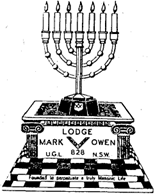
Original Lodge Mark Owen Logo
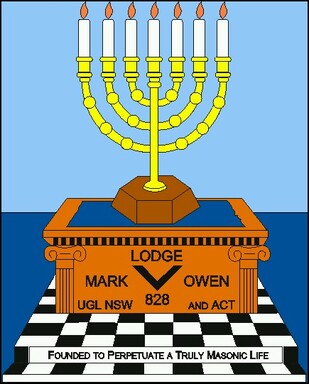
Current Lodge Mark Owen Logo
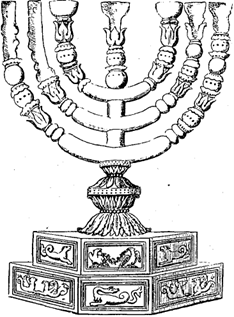
Reproduction of the Menorah from
the Arch of Titus
Original Lodge Mark Owen Logo
Current Lodge Mark Owen Logo
Reproduction of the Menorah from
the Arch of Titus
Bro. Rabbi L.A. Falk,
Chaplain to the Jewish Battalion in Palestine and the Australian Military Forces was initiated on 6/10/1924 in Lodge Balgowlah No. 392 and passed to the Grand Lodge above on 6/5/1957. Bro. Falk was, together with his sons Gerald and Balfour, a Foundation Affiliate of Lodge Mark Owen on 13/6/1951.
The emblem of the Lodge illustrated on the cover and frontispiece of this book was designed by RWor Bro. E.M. Humphery, P.J.G.W., who also created the Lodge's seal and made and presented its banner to the Lodge. The Menorah displayed at Lodge meetings was made and presented to the Lodge by Bro. Rabbi L.A. Falk.
The privileged task entrusted to me tonight is to expound the symbolic meaning and significance of the seven-branched candelabrum known in the V.S.L. as "Menorah," which has been chosen by the founders of Lodge Mark Owen to be its emblem. Before I attempted to carry out this task which has proved more arduous than at first, I anticipated. I feel I must add a. few words to the very fine tributes paid to the late Wor. Bro. Mark Owen by the Grand Master, M. Wor. Bro. F. McDowell, and by the Past Grand Master, M. Wor. Bro. John Goulston, at the consecration of this Lodge.
It was my privilege to know the late Wor. Bro. Mark Owen, even before I had the honour of joining Craft. I learnt then to esteem and admire his fine qualities and his special · gift for helping people with his well-weighed advice in their perplexities and difficulties. There is one particular Psalm of the royal bard David, the 24th, which should be of particular interest to Freemasons because of the legend that associates it with the building of King Solomon's Temple. This Psalm asks the question, 'Who may ascend the mount of the Lord, and who may stand in His holy place? ' And the answer is given by the poet, 'He who hath clean hands and a pure heart, who hath not set his heart upon vanity and hath not sworn deceitfully.' This Lodge, consecrated and named in memory of our late Brother Mark Owen, is, like all Lodges, symbolic of the Temple built on the Holy Mountain, and only those who strive earnestly to interpret in their corporeal life the spiritual significance of the ‘Temple’, which is the essence of Freemasonry, only deserves to find an abode for their souls in a Lodge typifying· that Temple.
And now, Wor. Master and Brethren, I proceed to the history, structure, and significance of the "Menorah."
I emphatically say that the Menorah is the most fitting subject to be chosen as a Masonic Emblem because it signifies most obviously, 'Light, in its widest application. Light was and is, as I shall point out later on, one of the great cardinal principles of Masonry.
Although tonight the symbolic significance of Light in general is not my subject, I shall say a few words on this basic point. Light has been accorded a vital significance in the religion and literature of all nations, from the most ancient to the present day. I need only mention Marduk and Shamash, chief deities among the ancient people of Babylonia; they were solar gods. The chief deity of the ancient Egyptians was Amun-Ra, also a solar god. Then we have Oromasdes or Ahura-Mazda, the solar luminary deity of the ancient Persians, who continues to receive honour to this very day among the important community of the Parsees in India and elsewhere. The apocryphal and apocalyptic literature, both Jewish and Christian, also make extensive use of the figure of 'Light' to typify the Divine influence which is active everywhere and at all times. In the Talmud as well as in the Christian scriptures, 'light' is also used as an expression to signify the conception of God as an all-controlling and all-pervading spirit. I must allude briefly to the role of 'light' in Masonry. You perceive the Lodge, its details and ornaments, by its lights, the greater and lesser Lights. The V.S.L., the Square and Compasses, technically called the furniture of the Lodge and without which no Lodge can exist, are also styled the 'great Lights of Masonry.' Masonry is a search after light: Light is the hope of the Candidate, which is brought to him by the Master and the help of the Brethren.
The Master of Light and Life, the Run and the Moon, an symbolised in every Lodge by the Master and Wardens, and this makes it the duty of the l\faster to dispense Light to the Brethren by himself and through the Wardens who are his ministers.-Th is makes it abundantly clear that the Menorah, which is now the emblem of Lodge Mark Owen, is a true symbol of Masonry, being par-excellence a symbol of the light to he found in the Temple.
The First Mention of the Menora h is to be found in the Book of Exodus (25, 31) in connection with the building of the 'Tabernacle’ as a symbol of the presence of the G.A.O.T.U. in the midst of Israel (for the Hebrew word “Mishkan,” not very well rendered 'Tabernacle,' signifies 'dwelling place,' from the verb "Shachen" 'to dwell'). The construction of the Menorah was according to a Divine pattern revealed to Moses during his seclusion in the Mount, as it is said, ‘See that thou make all things according to the pattern showed to thee in the Mount' (Ex. 26,40). The execution of this pattern was entrusted to the master-artist Bezalel, of whom the Bible speaks as "a man filled with the spirit of God in wisdom, in under standing and knowledge, and in all manner of workmanship:" in a word, he was an artist with all the necessary qualities for the interpretation of a sublime idea in inanimate materials. And indeed, among the many exquisitely wrought pieces of art that were in the Tabernacle and later on in the Temple built by our G.M. Hiram, the Menorah stood out in superlative beauty and wealth of symbolism. We are informed that it was hammered out from a solid piece of pure gold, of the weight of a talent, i.e., 931 lb. It was not cast in a mould nor was it allowed to be made in separate pieces and welded or soldered together. Anyone, even if not an expert in such work, will appreciate the magnitude of the task that confronted Bezalel, and the great skill he possessed in being able to shape this candelabrum with hammer and tools from one piece of gold. (At this point, it is worthwhile to mention that according to Josephus, who, being a priest, must surely have seen it. with his own eyes, the Menorah of the Second Temple was cast, and not hammered out. Whatever the case may have been with the Menorah of the Second Temple, there is no doubt that the Menorah made by Bezalel, which later on found itself in Solomon's Temple, was made in this way from a piece of solid gold.
The Menorah rose from a base, Yarech, in the form of a Central stem, Kaneh, from which three pairs of arms, Kanirn, branched out, curving outward and upward till they reached the same height as the central shaft. They were not arranged in pyramidal form, as some would maintain. The height of the Menorah was, according to traditions preserved in the Talmud, 18 palm-breadths (6feet) high, and the breadth across the top of the branches was, according to the same authority, half the height, i.e., 3 feet. There is no doubt that these measurements would fit in with the artistic balance of the Menorah.
The ornamentation which it bore, which is described in de tail in the V.S.L. and which also can be seen plainly on the Representation of the Menorah on the Arch of Titus, consisted of three kinds of decoration. First, Gviim, 'cups', shaped in the form of an almond-flower: these 'cups' were distributed, three on each branch and on the centre shaft four, one at the branching out of each pair of arms and the fourth probably beneath the centre lamp or, according to Rabbi Solomon Yishaqi, known as Raschi (flourished 11th century), above the base altogether, 22 'cups.' The second type of ornament, Kaftor, 'knobs,' were certainly spherical, being sometimes compared in the ancient literature to apples or pomegranates. Of these there were 11: how distributed I forebear to discuss, as there has been much contention on this point. The third type of ornament was Perah, "flowers" of what type is hard to say. Some say they were lilies: to the number of 9. Altogether 42, several ornaments. How Josephus arrives at his total of 70 (Ant. 2, 6, 7) is indeed hard to understand.
Bahr in his well-known and ponderous work on Symbolism (Symbolik des mosaischen Cultus) Deals at length with the significance of the ornaments; and the illustrious cabalist, Rabbi Isserles (16th cent.), in his famous work, Torat Haolah, also elaborates on the meaning of each ornament. But I shall not weary you with all the fine points raised.
The lamps, which were placed on the top of each of the seven stems, and which are noticeably missing from the representation on the Arch, were detachable lamps possibly in the ordinary oriental pattern to be seen in any museum: they usually have a spout through which the wick protrudes. The Talmud Menahoth, f 29, tells ns (and you must remember that the Talmud preserves the traditi01rn of those masters who had actually seen the Menorah, some of them being priests) that the wicks were all placed so as to face toward the centre lamp, to give the impression of all the lights forming the one Light: with the symbolic significance, that all Light emanates from the one source. The oil used in the lamps was prepared from olives, and its preparation took a week: it was not allowed to be used for any profane purpose or touched by profane hands. The history of the rededication by the Maccabees bears testimony to the fact that its preparation took some time. I assume I need not elaborate on this point, as most of the brethren will fully understand.
The lights on the side branches were lit only in the evening; that on the centre shaft, which was called the Ner-Hamaravi, 'Western Lamp', was kept burning continually. But on this subject also, there are divergencies of tradition, for according to Josephus, three lamps were kept burning during the day (Ant . 3, 8, 3).
The whole structure I have described, which according to the Talmud, Maimonides, Abarbanel, Rashi, and others, was triangular or in the form of a tripod, and finished off with clawed legs: the height of which was one foot and the width corresponded with that of the Menorah, i.e., 3 feet. It is obvious that if we take the base to have been in the form of a tripod, it is not the same as that on the Arch of Titus, which is hexagonal and in the form of two steps. Furthermore, in the representation on the Arch there appear animals figures an eagle and dragons; and this has given rise to the notion that the representation on the Arch could not have been a genuine one: first, because of the shape of the base; secondly, because these engraved figures, which would be, according to the prevailing view, so much in contravention of the rigorous prohibition by the Law of such representations. Hence, the suggestion that at least the base bearing these figures must have been the invention of the Roman artist. But it is interesting that recently, since the Menorah has been made the official device of the State of Israel, Maximilan Kon has demonstrated conclusively in the Palestine Exploration Quarterly (LXXXII, 25-30; Jan.-Ap:, 1950) that such animal representations were not contrary to Jewish tradition, and from this and other considerations he concludes that the Arch of Titus bears a reasonably faithful representation of the Menorah of the Second Temple. Here, I would mention that since the destruction of the Temple, it has been prohibited to reproduce copies of its furniture, even for use in a place of worship. It is for that reason, that an organ-which had been among the musical instrument of the Temple-is not installed in Synagogues. So also no seven-branched candlestick is permissible in Synagogue or home; eight-branched ones, however, are permitted. And, as a matter of fact, the emblem of our Lodge in its original form consists of a right-branched Menorah.
The position which the Menorah occupied was in the south, opposite the table of Showbread, which stood in the north, and in front of the veil separating the Holy of Holies from the Sanctuary. It was placed slantwise, with the lamps facing from East to South, and the centre light, which shone towards the West, was therefore called the 'Western Light.'
I come now to the symbolic aspect. Until now, I have spoken of the symbol of Light in general; now we must turn to the meaning of the Menorah. And in doing so, we must always bear in mind a cardinal principle enunciated by the Zohar, the Bible of Cabala, and other illustrious authorities, including also Philo himself, that the Tabernacle and Temple below symbolise that which is above. This point occupies an ·important place in Masonic teachings and the noted interpreter of Masonry, Bro. Albert Pike, in his book "Morals and Dogma," makes continuous reference to it.
The Menorah was not, we may safely say, for the giving of material light, to enable the priests to fin<l their way about in the darkened Sanctuary, which held no windows; otherwise it would not have been assigned its special place, nor the number of the lamps restricted to seven; moreover, only one lamp was burning during the day, the other six being lighted only during the night.
The purpose of the Menorah was to present a spiritual idea. Philo of Alexandria (first century) and other eminent commentators affirm that the seven branches with their lamps represent the seven planets, the centre branch (to which the others were turned) representing the sun. Some writers have urged objections against this, suggesting that it would not be in accord with Jewish ways of thought; but as a matter of fact, the Zohar (Num. f.148) itself says, 'Now, the lamps contain ai1 allusion to the celestial lamps, all of which are lit up together from the radiance of the Sun. In other interpretations are involved the seven sciences of the ancients, the seven celestial spheres or 'heavens,' and the number seven as connected with the seven days of creation. There is an interesting explanation, only to be fully appreciated by those familiar with the V. S. L. in the original, by which the numbers of the features of the Menorah arc made to refer to the initial verses of the books of Moses: the seven arms referring· to the seven words of the 1st. Verse of Genesis, the eleven knobs to the eleven words of Exodus l, 1, the nine flowers to Leviticus l, 1, the eighteen handbreadths of its height to Numbers, and the twenty-two cups to Deuteronomy. A cabalistic interpretation refers the sum of the seven of the branches and the numbers of ornaments (7 + 11 + 9 + 22 = 49) to the 49 paths of wisdom attainable by mortals, (the 5Oth being inaccessible to them.
All these interpretations have common features which lead us to sum up by saying that the Menorah itself is the symbol of wisdom, understanding, and knowledge, and therefore was placed opposite the Table of Showbread, which represented everything that is material in life. In the words of the famous Jewish commentator known as the M. L. Malbim, the 'Menorah is the symbol of the Greater Light of the future towards whose shining all nations shall come.' Taking all these interpretations into consideration, I think that the founders of the Lodge Mark Owen are to be congratulated for having selected so worthy an emblem for their Lodge. Now let us turn to the history of the actual Menorah itself. There is indeed a tradition that the first Menorah made by Bezalel, placed in the 1'1ishkan, the "Tabernacle," and later placed in the first Temple, was not the same as that in the second Temple: for at the time of the destruction of Solomon's Temple the priests hid the Menorah along with the Ark and various other articles. The Menorah of the Second Temple was constructed upon a similar pattern when the Temple was restored under Zerubbabel. Antiochus Epiphanes plundered it during his· desecration of the Temple, and we are not clear in what way it was replaced when the Temple was restored and rededicated by the Maccabees. In Herodian times, when the Temple was brought to a new height of splendour, we may be sure that the place of the Menorah was sumptuously filled, and the Menorah of this Temple, of course, remained in use until the fall of the City and the destruction of the Temple in the year 70 of the Common Era.
Then, at the fall of the City of Jerusalem, the Menorah, along with all the other appurtenances of the Temple which had been rescued from destruction by fire and otherwise, would be taken to Rome in the train of the conquerors. They were carried in the triumphal procession. It is to the sculptured representation of this procession that we owe the only large and detailed representation of the Menorah and other Temple furniture that have come down from contemporary artists to the present day: so the Roman in the rather insolent ceremonial of triumph preserved this design to serve in one day for the national emblem of the State of Israel, restored after 2,000 years.
After the spoils had been thus carried in triumph, they were later laid up in the Temple of Peace constructed by Vespasian, as Josephus relates, remarkable among its Roman fellows for beauty of architecture and the works of art collected within.
A hundred years later, during the reign of Commodus with whom the Decline and I<'all really set in, Vespasian's Temple of Peace was destroyed by fire. It seems clear from what will follow that the treasures of the Temple stored within it nevertheless did not suffer destruction.
We hear nothing further of the Menorah between this time and the spoliation of the City of Rome by the Vandals under Gaiseric in the• year 455 C.E., 385 years after the destruction of the Temple. On this occasion, we are informed by the 9th Century Greek official and monastic writer, Theophanes, the Menorah and other Temple spoils were loaded on board the Vandal ships and taken away with the other valuables to Carthage, to the Vandal kingdom established there.
Now we come to the last written testimony that has come down to us from antiquity, concerning our subject. In 533, the celebrated general Belisarius, the servant of the Eastern Emperor Justinian who tried to restore the old Empire now so fallen from its high estate, conquered the Vandal Kingdom in North Africa. Procopius, a conscientious historian who lived through these times, tells us that among the golden vessels and other treasures Belisarius had brought east were those from the Temple that Gaiseric had taken from Rome to Africa. And Procopius further tells us that a Jew, happening to see these treasures, caused word to reach the emperor's ear that it would not be well for them to be kept in the Palace of Byzantium: they could not be kept in any place but Jerusalem, otherwise calamity would overtake him. Alarmed at this, he tells us, Justinian ordered them to be sent away to the holy places of the Christians in Jerusalem.
This is the last we hear of the Temple treasures in veritable history. In the year 614, the Persians captured Jerusalem, and there is some record of the plunder they took from the Christian churches, but no mention in this connection of our subject or of any of the treasures from the Ancient Temple.
On the basis of these facts and other legends, however, a gifted and artistic Jewish writer, Stefan Zweig, has elaborated a most entrancing work (published in 1936), which I commend to those interested: "The Buried Candelabrum." With the resurrection of the Jewish State, which has already brought· about the resurrection of the figure of the Menorah as a living emblem, who can tell whether the actual buried Candelabrum may not yet reappear in all its glory, to radiate Light to all who aspire to construct the world on the spiritual foundations of King Solomon's Temple!
commodo ligula eget dolor. Lorem ipsum dolor sit amet, consectetuer adipiscing elit leget odiogil voluptatum similique fugit voluptates dolor. Libero assumenda, dolore, cum vel modi asperiores consequatur.